

Last Updated on November 4, 2025 by The Official Game Rules Team
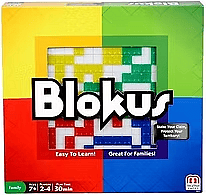
Blokus is a colorful, strategic board game where players compete to claim as much territory as possible using uniquely shaped tiles. The goal is simple: fit more of your pieces onto the board than anyone else before the end of the game. Whether you’re playing with friends, family, or solo, Blokus rewards clever planning, spatial reasoning, and tactical foresight.
Enjoy Blokus? Make sure to check out Blokus XL and Blokus Duo for even more block-placing fun!
This post contains affiliate links. For more information, see our disclosures here.
How to Play Blokus
Game Components
- 1 Game Board
- 84 Tiles in 4 colors (21 per color: red, blue, yellow, green)

Objective
The objective of Blokus is to place as many of your tiles on the board as possible. When the game ends, the player with the lowest number of squares left in their remaining pieces achieves the highest score and wins the game.
Setup
- Each player selects one color and takes all 21 tiles of that color.
- Determine playing order randomly; play proceeds clockwise.
- In the standard 4-player game, each player’s starting piece must cover one of the four corners of the board.
Gameplay
- On your turn, place one tile on the board.
- Every new tile must touch another tile of the same color corner-to-corner.
- Tiles of the same color cannot touch along edges.
- Tiles of different colors may touch freely at corners or edges.
- Once placed, tiles cannot be moved or rearranged.
- If a player cannot legally place another piece, they must pass.
- The end of the game occurs when no player can make another legal move.
During play, focus on spreading out early, securing open territory, and blocking opponents from connecting their pieces while leaving paths for your own expansion. Strategic corner connections and efficient use of your smallest piece near the end can make all the difference in your final score.
How to Win
Basic Scoring
- At the end of the game, count all the squares in your remaining pieces.
- The player with the lowest number of squares left unplayed achieves the highest score and wins.
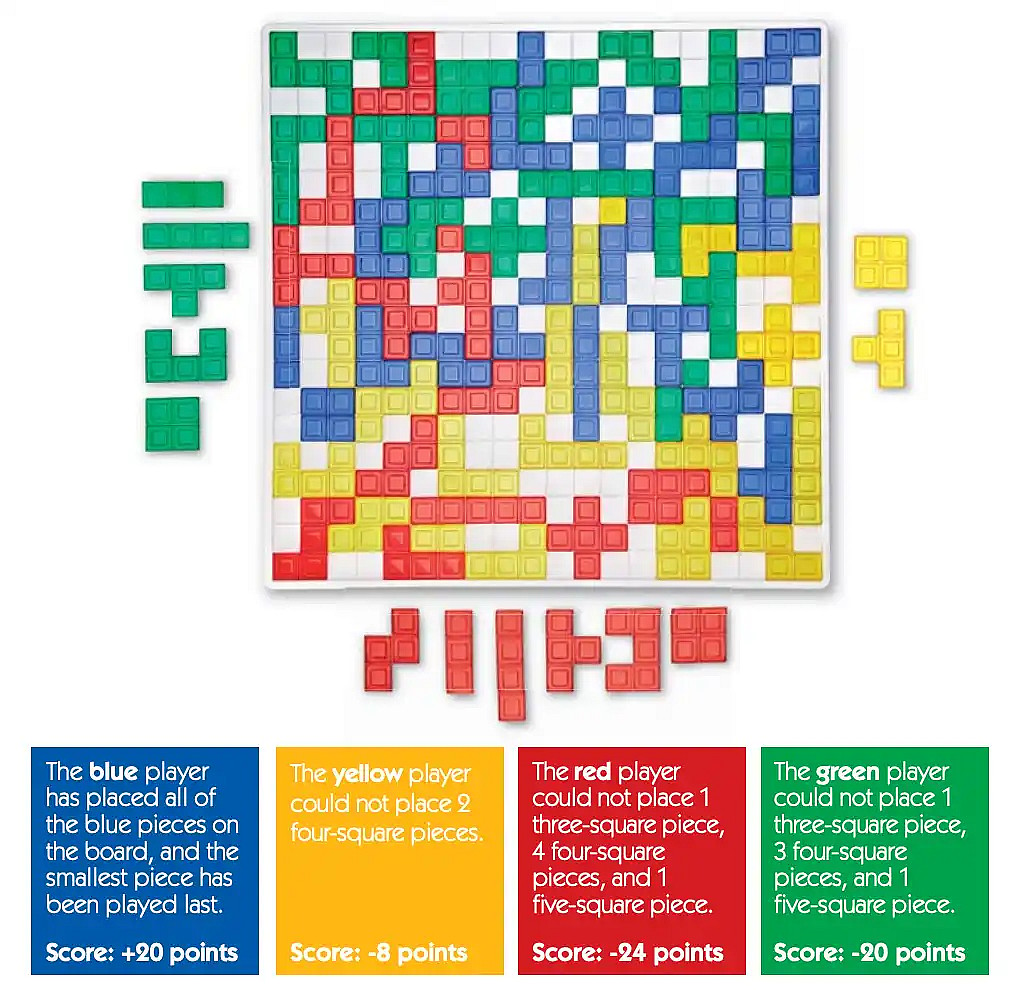
Advanced Scoring
- Subtract 1 point for each square in your remaining pieces.
- If a player successfully places all 21 tiles, they earn a +15 point bonus.
- If their final tile is the smallest piece (the single square), they receive an extra +5 points.
Game Variations
2-Player Game
- Each player controls two colors:
- Player 1: Blue and Red
- Player 2: Yellow and Green
- Playing order: Blue, Yellow, Red, Green.
- At the end of the game, combine both colors’ scores for each player.
3-Player Game
- Each player controls one color.
- The fourth color is shared and played in rotation.
- Playing order: Blue, Yellow, Red, Green.
- Only each player’s personal color counts toward their final score — the shared color’s remaining pieces are ignored.
Strategy Tips
Blokus is more than just a puzzle — it’s a contest of space, timing, and foresight. Strong players:
- Begin with a balanced starting piece that opens multiple directions for expansion.
- Keep options open by using pieces with more corners early and saving flexible tiles for tight spaces later.
- Block opponents when it limits their movement without restricting your own.
- Save your smallest piece for late-game opportunities where a single square can fit perfectly and earn crucial points.
Final Thoughts
Whether you’re playing the standard 4-player game or experimenting with game variations, Blokus combines tactical depth with quick play and endless replay value. Every match offers a new puzzle as you compete for the highest score, optimize your placement, and plan several moves ahead.
Mastering the art of tile placement, managing your remaining pieces, and thinking about the end of the game from your very first move will help you develop the best Blokus strategies for every number of players. Gather your tiles, pick your color, and see who can dominate the grid with the smartest moves and the fewest unplayed squares.
Blokus Rules – FAQ
A: To earn the highest score, place all your tiles on the board before the end of the game. Each unplayed square in your remaining pieces deducts one point, while placing all 21 tiles gives you a +15 bonus. If your final move is the smallest piece, you gain an extra +5 points.
A: The end of the game occurs when no player can legally place another tile. At that point, everyone counts the number of squares left in their remaining pieces to determine their score. The player with the lowest number of squares wins.
A: No. Tiles of the same color may only touch at the corners. However, tiles of different colors can touch along edges or corners without any restrictions.
A: Start by placing your starting piece in a corner that offers multiple expansion routes. Use larger tiles early, save smaller and flexible ones for tight spaces near the end of the game, and block opponents without limiting your own paths.
A: The standard 4-player game is the most popular version, but Blokus also supports game variations for 2 or 3 players. In 2-player games, each person controls two colors; in 3-player games, one color is shared and rotated between players.
A: If there’s a tie, the player who placed their last piece first — or placed more tiles overall — is usually declared the winner. You can also replay a quick round to break the tie.
A: Yes, solo play is a fun way to practice. The goal is to fit as many tiles as possible on the board and finish with the fewest remaining pieces.
A: In addition to the standard 4-player game, you can try Blokus Duo (a 2-player version on a smaller grid) or Blokus XL (a larger board for more strategic depth). Some players also experiment with custom game variations, like timed rounds or team play.
You may also like
 Official Magnetic Chess Game with Stones Rules
 Official Root Rules
 Official Gaia Project Rules
 Official The Lord of The Rings: Duel for Middle-Earth Rules
 Official Guess Who? Rules
 Official Bamboo Rules
 Official Rajas of The Ganges Rules
 Official Panda Royale Rules
 Official Checkers Rules
 Official The Night Cage Rules
 Official Quoridor Rules
Official Star Wars: Rebellion Rules
Official Quoridor Rules
Official Star Wars: Rebellion Rules