

Last Updated on February 12, 2026 by The Official Game Rules Team
Caribbean Stud Poker is a popular casino game that blends the structure of traditional five-card stud with the simplicity of a house-banked table game. Originally developed in the Caribbean—often linked to Aruba—the game quickly spread to casinos worldwide and became a staple table game alongside blackjack and poker roulette.
Unlike a traditional poker game where players compete against each other, the game of Caribbean Stud Poker pits each player directly against the dealer. There is no bluffing, no drawing cards, and no complex betting rounds. Instead, players receive a five-card hand, evaluate their own cards, and decide whether to fold or raise. Because of its straightforward format and fixed payout structure, Caribbean poker is considered one of the easiest casino games to learn. While there is some strategy involved, the optimal strategy can be summarized into a few simple rules that significantly reduce the house edge.
This guide explains everything you need to know: betting options, hand rankings, payouts, progressive jackpot details, Caribbean Stud Poker strategy, odds, and helpful tips for beginners.
This post contains affiliate links. For more information, see our disclosures here.
How to Play Caribbean Stud Poker
What Is Caribbean Stud Poker?
Caribbean Stud Poker is a casino game derived from five-card stud. It is played with a standard 52-card deck of cards, with no jokers added. All standard poker hand rankings apply.
Each round begins with players placing an ante bet. After betting, each player and the dealer receive five cards. One dealer card is dealt face up (known as the dealer card), while the remaining dealer cards are face down.
Players look at their own cards and decide whether to:
- Fold (forfeit the ante wager)
- Raise (place an additional bet equal to twice the ante amount)
The dealer must qualify with ace-king or better in order to compete. If the dealer does not qualify, the ante pays and the raise pushes. If the dealer qualifies, the best five-card hand wins according to standard poker hand rankings.
Table Setup and Equipment
Caribbean Stud is played at a designated Caribbean Stud Poker table inside a casino. The table layout includes:
- Ante betting circle
- Raise betting circle
- Progressive jackpot side bet area
- Printed following pay tables for quick reference
The dealer uses a standard deck of cards, which is shuffled either manually or by an automatic shuffler. After shuffling, cards are dealt from the top of the deck in accordance with house procedures.
Players use chips to make wagers. Each casino establishes a minimum table limit and a maximum limit. The ante amount must fall between these limits.
Betting Options in Caribbean Stud Poker
There are three primary wagers in Caribbean Stud:
- Ante wager
- Raise wager
- Progressive jackpot side bet
Let’s break them down.
The Ante Bet
The ante bet is mandatory. Without placing the ante wager, you cannot receive cards.
Before any cards are dealt, each player places chips in the ante circle. The wager must meet the minimum table requirement and cannot exceed the maximum.
If you later beat the dealer’s hand, the ante pays 1:1. If the dealer does not qualify, the ante still pays 1:1. If you tie exactly, the ante pushes. If you lose, the ante is lost.
The Raise Bet
After receiving your own cards and seeing the dealer card, you must choose to fold or raise.
If you raise, you must place an additional bet equal to exactly two times your ante amount. No more, no less. This fixed structure keeps the game simple.
If the dealer qualifies with ace-king or better:
- If you have the winning hand, the raise pays according to the paytable.
- If the dealer’s hand wins, you lose both wagers.
- If tied, both wagers push.
If the dealer fails to qualify:
- Ante pays 1:1
- Raise bet pushes
Raise Payout Table
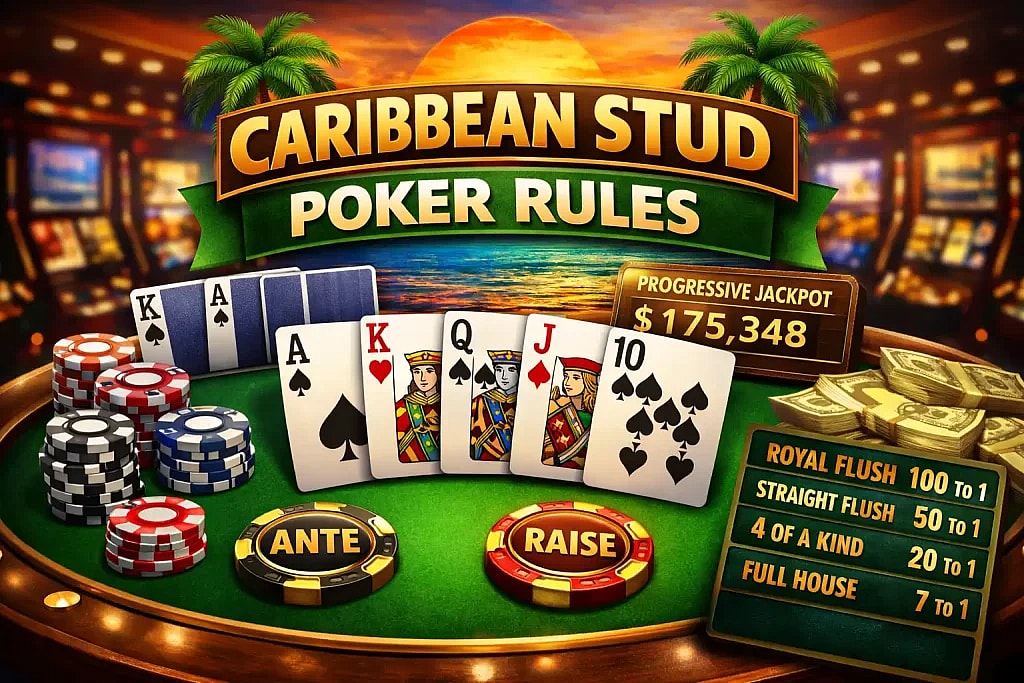
The raise payout depends on your five-card hand. Most casinos use a version of the following pay tables:
- Royal flush – 100:1
- Straight flush – 50:1
- Four of a kind – 20:1
- Full house – 7:1
- Flush – 5:1
- Straight – 4:1
- Three of a kind – 3:1
- Two pair – 2:1
- One pair or high card – 1:1
These payouts apply only if the dealer qualifies.
Progressive Jackpot Side Bet
Many casinos offer a progressive jackpot side bet. This is an optional additional bet, usually $1.
If you place the progressive jackpot side bet, you become eligible for bonus payouts based solely on your own cards. The dealer’s hand does not matter for this wager.
Typical payouts:
- Royal flush – 100% of jackpot meter
- Straight flush – 10% of jackpot
- Four of a kind – fixed bonus
- Full house – fixed bonus
- Flush – smaller fixed bonus
When someone hits a royal flush, the jackpot meter resets to a seed amount.
This side bet increases the house edge significantly but offers the excitement of a large bonus payout.
Step-by-Step: How a Hand Is Played
1. Place Your Wagers
All players place their ante bet. Optional progressive jackpot side bet may also be placed.
2. Cards Are Dealt
The dealer deals five cards to each player face down. The dealer also receives five cards, but only one dealer card is face up.
3. Evaluate Your Own Cards
You examine your five-card hand and compare it against the visible dealer card.
4. Fold or Raise
You must either:
- Fold and surrender your ante
- Raise by placing 2x the ante wager
5. Dealer Reveals Cards
The dealer turns over the remaining four cards. Verification procedures ensure fairness.
6. Dealer Qualification
The dealer must have ace-king or better. If not, the raise bet is void and pushes.
7. Compare Hands
Hands are ranked according to poker hand rankings:
- Royal flush
- Straight flush
- Four of a kind
- Full house
- Flush
- Straight
- Three of a kind
- Two pair
- One pair
- High card
Suits (clubs, diamonds, hearts, spades) have no ranking value in this casino game.
8. Payouts
Winning hand results in:
- Ante paid 1:1
- Raise paid according to paytable
Losing hand results in loss of both wagers.
Dealer Qualification Explained
The dealer must have ace-king high or better to qualify.
If the dealer shows ace-king high, that means:
- Ace and king are present
- No pair or stronger combination
If dealer fails to qualify:
- Ante pays 1:1
- Raise pushes
Dealer’s rank matters heavily in Caribbean Stud Poker strategy decisions.
Caribbean Stud Poker Strategy
Although simple, using proper Caribbean Stud Poker strategy significantly reduces the house edge.
Core Simple Rule
Always raise with a pair or better.
Always fold if your hand is weaker than ace-king high.
Beyond that, optimal strategy requires evaluating the dealer card and kicker strength.
Advanced Decision Rules
Raise with ace-king if:
- Dealer card is between 2 and queen and matches one of your cards.
- Dealer card is ace or king and you hold a queen or jack.
- Dealer’s upcard does not match your fourth-highest card.
Otherwise, fold.
These refinements bring the house edge down to approximately 2.56% when using optimal strategy.
Odds and House Edge
Caribbean Stud Poker has a house edge of around 5% if played poorly.
Using optimal strategy reduces it to about 2.5%.
The progressive jackpot side bet dramatically increases house edge and should be treated as entertainment rather than value play.
The odds of rare hands:
- Royal flush: 1 in 649,740
- Straight flush: 1 in 72,193
- Four of a kind: 1 in 4,165
Because there is no drawing phase, improving hands is impossible.
Tips for Playing Caribbean Stud
- Stick to optimal strategy.
- Avoid chasing the progressive jackpot.
- Manage your maximum bet carefully.
- Understand dealer qualification rules.
- Review pay tables before sitting down.
- Respect table minimum and bankroll size.
Alternate Rules and Variations
Some casinos use alternate rules, including:
- Dealer qualifying with queen-high instead of ace-king.
- Modified pay tables.
- Higher minimum table requirements.
Always check posted rules before playing.
Similar Games
If you enjoy Caribbean Stud, consider:
Each is a poker-based table game with unique betting structures.
Frequently Asked Questions
It is primarily a casino game with fixed odds, but proper strategy reduces the house edge.
Both wagers push.
No. Spades, hearts, diamonds, and clubs are equal.
A royal flush is the highest-ranking hand.
No. The raise must be exactly twice the ante amount.
It offers a large bonus but increases house edge significantly.
Your ante pays and raise pushes.
Conclusion
Caribbean Stud Poker remains one of the most accessible and entertaining poker-based table games in the casino. With a simple rule structure—ante, fold or raise, compare hands—it is easy for beginners to learn and quick to play.
The key to long-term success is following Caribbean Stud Poker strategy carefully. Always raise with a pair or better. Be cautious with ace-king high. Pay attention to the dealer card and dealer’s rank before committing additional wagers.
While the progressive jackpot side bet offers eye-catching payouts and a growing meter, disciplined players focus on the main game and manage bankroll wisely.
Whether you’re sitting at a Caribbean Stud Poker table for the first time or refining your optimal strategy, understanding the odds, payouts, and house edge ensures you get the most enjoyment out of every five-card hand.
Browse Related Games!
 Official Think ‘N Sync Rules
 Official Dealer’s Choice Poker Rules
 Official Canadian Salad Rules
 Official Sergeant Major Rules
 Official Casting Shadows Rules
 Official Fog of Love Rules
 Official Bird Call Rules
Official Twenty-Nine Rules
Official Bird Call Rules
Official Twenty-Nine Rules
 Official Tell Me Without Telling Me Rules
Official Texas Hold’em Rules
Official Tell Me Without Telling Me Rules
Official Texas Hold’em Rules
 Official Charty Party Rules
Official Rummy 500 Rules
Official Charty Party Rules
Official Rummy 500 Rules