

Last Updated on March 3, 2026 by The Official Game Rules Team
Dittle (also called Dittle Dice Battle) is a two-player strategy game where you race seven dice across a wooden board, tilting and jumping your way toward your opponent’s back row. It’s easy to pick up, plays fast, and rewards smart planning over luck. In fact, after the very first roll to decide who goes first, luck plays no part at all — every decision is yours.
If you enjoy games that mix movement, positioning, and a little bit of math, Dittle is a great fit. Fans of Chess often take to it quickly, since both games are built around advancing pieces while keeping an eye on what your opponent is doing.
Below you’ll find every Dittle rule explained in plain language, plus tips, strategy, and answers to common questions.

This post contains affiliate links. For more information, see our disclosures here.
How to Play Dittle Dice Battle
Overview
Players: 2 | Ages: 6 and up | What’s included: 1 wooden board, 7 black dice, 7 white dice
What’s in the Box
Every Dittle set comes with a wooden game board, seven black dice, and seven white dice. One player takes the black set and the other takes the white set.
The board is sealed with a water- and weather-resistant finish, but it’s best stored indoors. Avoid leaving it in wet or humid conditions to keep it looking its best over time.
Objective of the Game
Your goal is to move all seven of your dice into your opponent’s base row — the row of squares on their side of the board. But simply getting there first doesn’t automatically win the game. Once the board is filled, the player whose dice show the highest combined total (the sum of all upward-facing numbers) is the winner.
This means you’re always thinking about two things at once: getting your dice across and making sure they arrive showing high numbers.
Setup
Setup is quick and the same every game.
Each player places their seven dice in the row of squares closest to them. This is your base row. Every die must be placed with the number 6 facing up and the number 3 facing toward you. Both players set up identically before the game begins.
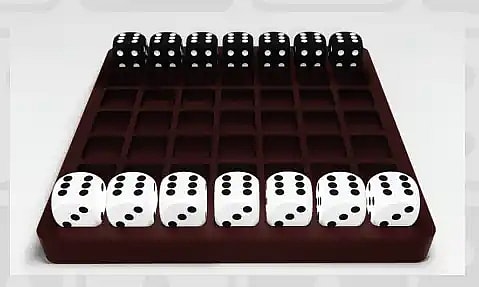
Who Goes First
To decide who moves first, both players each roll two dice at the same time. The player with the higher combined total goes first. If there’s a tie, roll again until one player wins the toss.
After the first player is decided, turns alternate back and forth for the rest of the game.
Legal Moves
On your turn, you move one die using one of the following legal moves. Each move type either changes or preserves the number facing up on your die — and that matters a lot when scoring at the end.
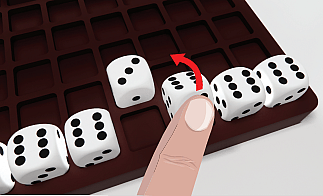
TILT FORWARD: Roll one of your dice one square forward. The die tips over and its upward-facing number changes.
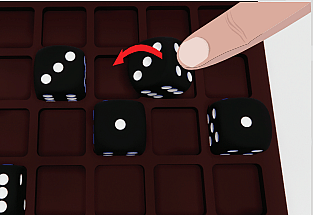
TILT SIDEWAYS: Roll one of your dice one square to the left or right. The die tips over and its upward-facing number changes.
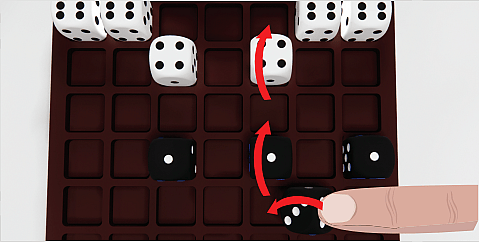
TILT + JUMP VERTICAL: Tilt your die forward or sideways once, then jump over one or more dice in a straight vertical line. The upward-facing number must not change during the jump.
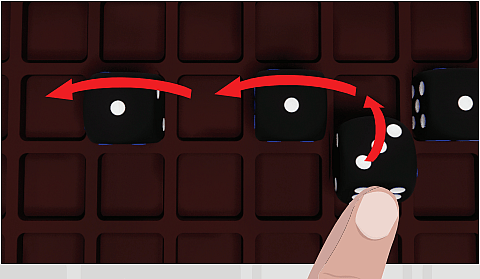
TILT + JUMP HORIZONTAL: Tilt your die forward or sideways once, then jump over one or more dice in a straight horizontal line. The upward-facing number must not change during the jump.

JUMP VERTICAL: Jump over one or more dice in a straight vertical line without tilting first. The upward-facing number stays the same throughout the move.
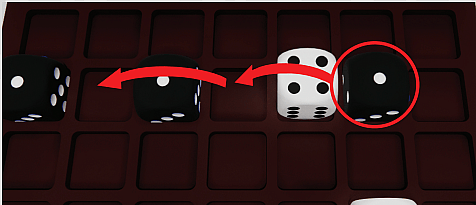
JUMP HORIZONTAL: Jump over one or more dice in a straight horizontal line without tilting first. The upward-facing number stays the same throughout the move.
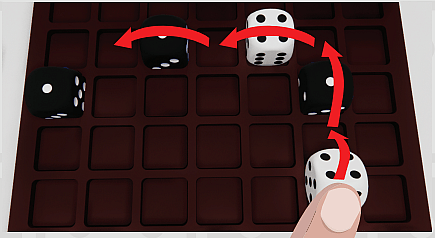
TILT + JUMP MIXED: Tilt your die forward or sideways once, then combine a vertical and horizontal jump — similar to an L-shape — over one or more dice. The upward-facing number must not change during the jump.
Note: When jumping over multiple dice in a row, there must be at least one empty space between each die being jumped. You cannot leap over a tight cluster of dice with no gaps between them. You can jump over both your own dice and your opponent’s dice.
What You Cannot Do
There are three things that are never allowed in Dittle:
- You cannot move backward. All movement must go forward (toward your opponent’s side) or sideways.
- You cannot move diagonally in any direction.
- You cannot spin or rotate a die in place to change its upward-facing number. The die must actually move to a new square for any number change to count.
Advancing Once Inside the Opponent’s Base Row
Getting a die into your opponent’s base row doesn’t mean it’s done moving. You can continue tilting that die forward or sideways within the base row to increase its upward-facing number. This is one of the most important things to understand in Dittle — arriving with a 2 and tilting up to a 5 before the game ends can easily decide the winner.
How to Win Dittle
The game ends the moment one player has all seven of their dice in the opponent’s base row.
At that point, both players add up the upward-facing numbers on all of their dice in the opponent’s base row. The player with the higher total wins.
The first player to fill the opponent’s base row is not automatically the winner. Scoring is everything. A player who rushed across with low numbers can lose to a player who took their time and arrived with high ones.
Dittle Clash – Faster Variant
Dittle Clash is a quicker, more aggressive version of the game. If you want a shorter match with more direct confrontation, this is the mode to play.
The goal changes completely: you only need to get one die to the opponent’s base row to win. But dice can now clash and eliminate each other, so it’s not as simple as it sounds.
Dittle Clash follows all the basic rules of Dittle Battle with the following differences:
- No jumping. Only the Tilt Forward and Tilt Sideways moves are allowed. No jump moves of any kind.
- Clashing eliminates dice. If your die moves into a square occupied by an opponent’s die, the die showing the lower number is removed from the board entirely.
- Surrounded by multiple dice? If one of your dice is adjacent to two or more of your opponent’s dice, add up the upward-facing numbers of all the surrounding opponent dice and compare that sum to your die’s number. Whichever is lower is eliminated — either your single die or all the surrounding ones.
- Ties eliminate everyone. If your die clashes with an opponent’s die showing the same number, or if a surrounded die matches the sum of the surrounding dice, all involved dice are eliminated.
First to cross wins. The moment any one of your dice reaches the opponent’s base row, the game is over and you win. You do not need to fill the entire row.
Tips for Beginners
Don’t treat Dittle as a pure race. A die that crosses quickly but arrives showing a 1 or 2 is almost worthless at scoring time. Think about arrival numbers, not just arrival speed.
Use jump moves to protect high numbers. Jump moves don’t change your upward-facing number. If a die is already showing a 5 or 6, jump it across the board rather than tilting, so you preserve that value.
Keep tilting once you’re in the base row. After a die lands in your opponent’s base row, don’t forget you can keep tilting it to increase its number before the game ends.
Pay attention to your opponent’s numbers. If they have a die parked in your base row showing a 6, you need to respond — either by outscoring them elsewhere or by finishing faster with higher numbers.
Spread your dice across the board. A wide spread gives you more movement options and makes it harder for your opponent to predict your path.
Strategy
Think about arrival numbers, not just arrival speed.
The most common beginner mistake is playing Dittle like a racing game. The winner is determined by the sum of upward-facing numbers, not by who crosses first. A die that crosses slowly while maintaining a 6 is worth far more than one that races across showing a 2.
Use jump moves to “freeze” high numbers.
Jump moves (without a prior tilt) don’t change the upward-facing number. Once a die is showing a 5 or 6, switch exclusively to jump moves to carry it across the board without losing that value.
Control the center.
Dice positioned toward the middle of the board have more movement options and can threaten multiple lanes at once. Spreading through the center makes it harder for your opponent to anticipate and block you.
Track what your opponent is scoring.
Always be aware of the numbers your opponent’s dice are showing, especially any that are already in your base row. If their total is climbing, you may need to wrap up the game quickly or focus on boosting your own numbers.
In Dittle Clash — pick your clashes carefully.
In the Clash variant, getting eliminated is a serious setback. Only move a die into a clash when yours is showing a higher number. Protect your strongest die and use it to make the crossing run.
Frequently Asked Questions
Yes. Jump moves can be made over both your own dice and your opponent’s dice. There’s no restriction on which color you leap over.
No — not in standard Dittle Battle. A jumping die must land in an empty square on the other side. Dice don’t stack or capture each other in the standard game. Elimination only happens in Dittle Clash.
The official rules don’t cover this directly. If all your dice are completely blocked, agree with your opponent before the game starts on whether the blocked player passes their turn or if the game ends.
No. Backward movement is not allowed under any circumstances. All movement must go forward or sideways.
Since players always alternate turns, only one player can make a move at a time. Whoever reaches the opponent’s base row on their turn wins — the other player doesn’t get a final move to match.
Video Tutorial
Conclusion
Dittle – Dice Battle is one of those games that looks simple at a glance but reveals a lot of depth once you start playing. The tilting mechanic ties movement directly to scoring, which means every decision carries real weight. Whether you’re playing the full Dittle Dice Battle or jumping into the faster Dittle Clash variant, the game rewards players who think a few moves ahead.
If you enjoy Dittle’s mix of positioning and advancement, Checkers is another great two-player game worth trying. It’s built around the same core idea — advancing pieces toward your opponent’s back row with jumping mechanics at the heart of the gameplay.
Browse Related Games!
 Official The Lord of The Rings: Duel for Middle-Earth Rules
 Official Gaia Project Rules
 Official Panda Royale Rules
 Official Magnetic Chess Game with Stones Rules
 Official Bamboo Rules
 Official Mancala Rules
 Official The Night Cage Rules
Official Mycelia Rules
Official The Night Cage Rules
Official Mycelia Rules
 Official Jinx Rules
 Official Rajas of The Ganges Rules
 Official Santorini Rules
 Official Root Rules