

Last Updated on January 23, 2026 by The Official Game Rules Team
Ludo is a timeless and popular board game enjoyed by players of all ages. It combines simple dice-rolling mechanics with strategic movement and competition. The goal is to navigate your pawns safely around the board and bring them home before your opponents do. Whether you’re a beginner or looking to sharpen your skills, understanding the core rules is essential to playing well and having fun.
This post contains affiliate links. For more information, see our disclosures here.
How to Play Ludo
Objective
Ludo is a classic board game played with dice and pawns. The goal is to be the first player to move all four of your pawns from the starting area to your home area by rolling the dice and moving strategically around the board.
Number of Players
Ludo is designed for 2 to 4 players. In many versions, including the Ludo Culture app, games are commonly played with either 2 or 4 players.
Basic Gameplay
Moving Pawns
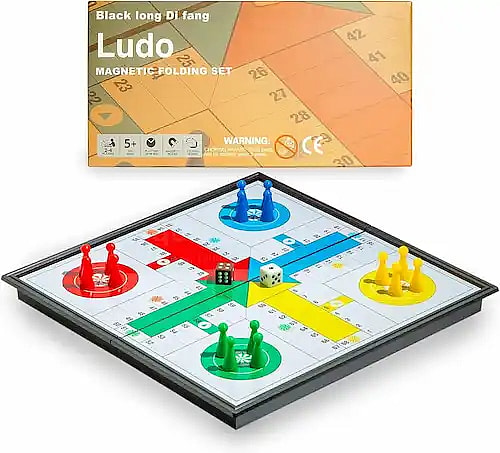
- Each player starts with four pawns in their starting area (the circle of their color with 4 empty sapces inside).
- To start the game, players take turn rolling until they get a six. When a six is rolled, that player may move one of their pawns from their circle, onto their colored track start square (typically in front of their circle).
- Once you have at least one piece on the board and roll a six, you may choose either to bring a new piece into play or to move one of your existing pieces forward along the track.
- Players take turns rolling the dice and move their pawns forward by the number rolled. For example, if you roll a 3, you can move one of your pawns three spaces forward on the board.
- Pawns travel along a fixed track around the board and enter their colored home area, which has six squares (this can change depending on the version). The last square is the final home or finish zone.
Eliminating Opponents’ Pawns
- If your pawn lands exactly on a square occupied by an opponent’s pawn, you “capture” or eliminate that pawn. The opponent’s pawn is sent back to its starting area, and the player who captured it gets an extra turn to roll the dice again.
- If a pawn lands on a square occupied by another pawn of the same color, it forms a block. This block protects those pawns from being captured by opponents. Only versions of the game with a board similar to the one in the photo at the top of the page can use this rule. If your board only has single spaces, instead you are not allowed to ‘stack’ pawns. Pawns of the same color cannot occupy the same space.
- To open a block, the player must roll a six. Blocks are useful for strategic defense.
Safe Zones
- The squares immediately in front of each player’s starting area are designated safe zones where pawns cannot be captured.
- Additionally, if two pawns of the same color occupy the same square, that tile temporarily becomes a safe zone, preventing opponents from capturing those pawns.
Turn Order and Timing (Optional)
- Players take turns rolling the dice in clockwise order.
- To make things more interesting, each player has only 10 seconds to make their move. If they do not move within this time, their turn is skipped, and play passes to the next player.
Winning the Game
- The game is won by the first player who successfully moves all four of their pawns from the starting area to the home or finish zone.
- In some versions like Ludo Culture, players also accumulate points: 1 point for every tile moved and 56 points for each pawn that reaches the finish zone. The player with the highest points can also win.
Additional Tips and Strategies
- Spread your pawns around the board to increase mobility and reduce risk.
- Use blocks to protect your pawns and prevent opponents from capturing them.
- Pay attention to opponents’ positions and try to capture their pawns to slow them down.
- Be cautious when moving pawns close to the home area, as opponents often target them there.
- Don’t automatically use sixes to bring a new piece in. If your opponents have many pawns close behind, it might make more sense to move an existing piece forward (otherwise they have a good opportunity to bounce you).
Summary of Key Rules
| Rule | Description |
|---|---|
| Starting Movement | Pawns begin in open position; no need to roll a six to start. |
| Movement | Move pawns clockwise according to dice roll. |
| Capture | Landing on opponent’s pawn sends it back to start. |
| Blocks | Two pawns of same color on a tile create a block. |
| Safe Zones | Designated safe squares and blocks prevent capture. |
| Extra Turns | Roll a six to get an additional roll. Three sixes in a row lose the turn. |
| Time Limit | 10 seconds per turn; turn skipped if time runs out. |
| Winning | Move all four pawns to home first or earn highest points. |
Frequently Asked Questions (FAQ)
A: In traditional Ludo, yes. But in some versions like the Ludo Culture app, pawns start in open position and can move without rolling a six.
A: You form a block that protects your pawns from being captured by opponents. This block can only be broken by rolling a six.
A: Yes, if you land exactly on their pawn’s square, you send it back to their start area and earn an extra turn.
A: You lose your turn and play passes to the next player.
A: Yes. Each player has a safe zone near their start, and blocks formed by two pawns of the same color create temporary safe zones.
Conclusion
Ludo is a game of both chance and strategy, blending the excitement of dice rolls with tactical pawn movements. Knowing the rules clearly helps you make smarter moves, protect your pawns, and seize opportunities to capture opponents. Whether playing casually with friends or competing in an app version, mastering these rules will improve your gameplay and increase your chances of victory. Get ready to roll the dice and enjoy the timeless fun of Ludo!
Ludo and Sorry! are similar classic board games focused on racing pawns home while interacting with opponents’ pieces. However, Sorry! adds more strategic variety through special cards and unique movement rules, while Ludo keeps it simple with dice rolls and movement around the board.
If you enjoy one, you might like the other—both are fun family-friendly games that combine luck and strategy.
Browse Related Games!
 Official Mancala Rules
 Official Gaia Project Rules
 Official Santorini Rules
 Official Concordia Rules
 Official Jinx Rules
 Official TOSY Flying Ring Rules
 Official The Lord of The Rings: Duel for Middle-Earth Rules
 Official Lost Ruins of Arnak Rules
 Official Bamboo Rules
 Official Clue Escape: The World’s Fair Rules
 Official The Night Cage Rules
 Official Cubitos Rules