

Last Updated on February 12, 2026 by The Official Game Rules Team
Sorry! is a classic family board game for 2–4 players, ages 6 and up. With a deck of action cards, unpredictable movement, and plenty of chances to send an opponent back to start, every turn can change the course of the game. The object of the game is simple: be the first player to move all three of your pawns from your start area, around the board, and safely into home.
Despite its easy setup and quick turns, Sorry! rewards clever timing, awareness of opponents’ positions, and smart use of the powerful sorry card.

This post contains affiliate links. For more information, see our disclosures here.
How to Play Sorry!
Game Components
- Gameboard
- 12 Sorry! pawns (3 per color)
- 45 cards
Each player controls three pawns of a single color.
Object of the Game
The object of the game is to be the first player to move all three of your pawns from your start area, around the board, and into your home by exact count.
Setup
- Each player selects a color and places their three pawns in the matching start area.
- Shuffle the deck and place it face down in the center of the board.
- The youngest player takes the first move. Play continues clockwise to the left.
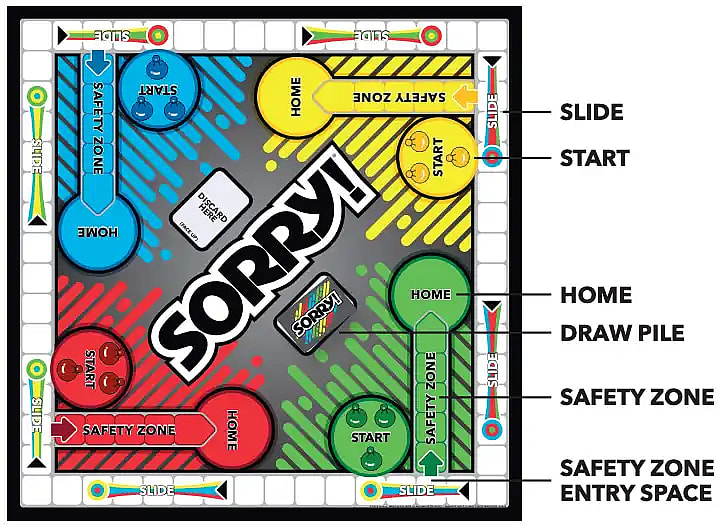
How a Turn Works
On your turn:
- Draw one card from the deck.
- Follow the instructions on the card.
- Place the card face up in the discard pile.
If the draw pile runs out, shuffle the discard pile to create a new deck.
If you cannot make a legal move, your turn ends. However, if a legal move is available, you must take it—even if it benefits an opponent.
Starting a Pawn
To move a pawn out of start, you must draw a forward-moving card. Any card that moves a pawn forward can be used for your first move to bring a pawn into play.
Once in play, pawns move clockwise around the board unless a card instructs otherwise.
Moving Around the Board
Jumping and Bumping
You may jump over your own pawns and your opponents’ pawns while counting spaces. However, if you land on a space occupied by one of your opponents’ pawns, you bump that pawn back to its start area.
You may not land on a space occupied by one of your own players’ pawns. If that is your only possible move, you forfeit your turn.
Slides
Slides are one of the most aggressive mechanics in the game.
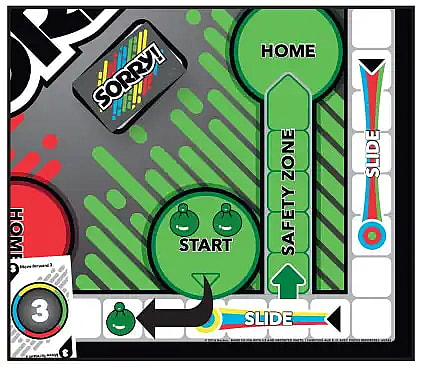
If you land by exact count on the triangle at the start of a slide that matches your pawn’s color, you must slide forward to the end of that slide. Any pawns in the path—whether they belong to you or your opponent—are sent back to their start areas.
If you land on a slide that does not match your color, you do not slide.
Slides can dramatically shift board control and are often key to slowing down opponents.
Safety Zone
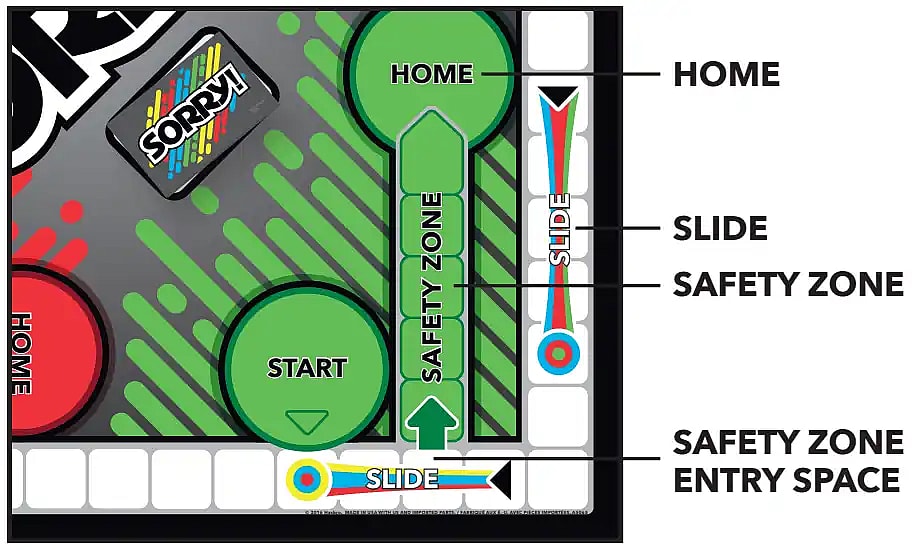
Each player has a safety zone near their home.
- Only you may enter your own safety zone.
- No pawn may enter its safety zone on a backward move.
- A pawn may move backward out of its safety zone if a card requires it.
- All normal movement rules still apply inside the safety zone.
When traveling on the outer track, you may not move forward past your safety zone entry space. However, you may pass it if moving backward (such as with a 4 or 10 card).
Home
- You must enter home by exact count. If you overshoot, you cannot move that pawn.
- Once a pawn reaches home, it stays there for the rest of the game.
- The end of the game occurs immediately when one player successfully gets all three of their pawns home.
The Cards
| Card | Action |
|---|---|
| 1 | Move a pawn forward 1 space. Can be used to leave Start. |
| 2 | Move a pawn forward 2 spaces. Can be used to leave Start. Draw again. |
| 3 | Move a pawn forward 3 spaces. |
| 4 | A player who has a pawn in the Safety Zone and draws a “4” must move that pawn backward 4 spaces if he has no other man in play |
| 5 | Move a pawn forward 5 spaces. |
| 7 | A player may move a pawn Home with a split “7”, provided he has another pawn in play to complete the full move of 7 squares in all. Providing the full 7 squares are moved, a split “7” may be used to move 2 pawn into Home, return 2 opponents’ pawns to Start, use 2 Slides, or combination of any of the above. A “7” must not be used to Start a Pawn Out and must not be used to move a piece backward. |
| 8 | Move a pawn forward 8 spaces. |
| 10 | A player drawing a “10” and being unable, or not wishing, to move a pawn forward 10 spaces must move a pawn backward 1 space even if that pawn is in the Safety Zone.. |
| 11 | A player drawing an “11” forfeits the move if it is impossible for him to move one of his pawns forward 11 spaces and if he does not wish to change places with any Margin pawns of an opponent. |
| 12 | Move one of your pawns forward 12 spaces. |
Special Rules to Remember
- Only one of your pawns may occupy a single space at a time (except in start or home).
- You must move if you can.
- Exact count is required for entering home.
- Slides can bump even your own pawns.
- Switching with an 11 card does not allow switching with pawns in safety zones.
Understanding these special rules prevents costly mistakes.
Winning the Game
The first player to move all three pawns to their Home wins!
Strategy Tips
1. Don’t Rush All Pawns Out Immediately
While it may seem smart to move all players’ pawns into play quickly, spreading too thin can make you vulnerable. Sometimes it’s better to advance one pawn steadily.
2. Control the Slides
Landing on your own color slides at the right moment can send multiple opponents’ pawns back to start. Watch spacing carefully.
3. Use the Sorry Card Strategically
The sorry card is strongest when used against a leading opponent or someone close to entering their safety zone.
4. Think Before Splitting a 7
Splitting can be powerful but may expose two pawns instead of advancing one safely.
5. Position for the End Game
As the end of the game approaches, focus on exact counts and avoid overshooting your safety zone entry.
Advanced Tactical Advice
- Sometimes moving backward with a 4 or 10 can set up a powerful slide.
- Swapping with an 11 can place you dangerously close to home.
- Protect pawns inside your safety zone whenever possible.
- Target the strongest opponent rather than retaliating emotionally.
Sorry! may look simple, but experienced players know timing is everything.
Frequently Asked Questions
No. Pawns cannot enter the safety zone on a backward move.
No. The 11 card only allows switching with pawns on the open track.
No. You may jump over your own pawns, but you cannot land on them.
If no legal move exists, your turn ends.
Yes. If you split the 7, you must use all spaces.
The end of the game happens immediately when one player gets all three pawns home by exact count.
Conclusion
Sorry! remains a timeless family favorite because of its blend of luck and tactical movement. From dramatic slides to well-timed sorry card plays, every turn presents a new opportunity to advance—or send an opponent back to start. By understanding the object of the game, mastering the special rules, and planning around the safety zone and slides, you can consistently improve your chances of winning.
Whether you’re playing casually with kids or competitively with experienced players, smart positioning and careful card use will make all the difference.
Browse Related Games!
 Official Concordia Rules
 Official Clue Escape: The World’s Fair Rules
 Official Cubitos Rules
 Official Mancala Rules
 Official The Lord of The Rings: Duel for Middle-Earth Rules
 Official Gaia Project Rules
 Official Bamboo Rules
 Official The Night Cage Rules
 Official Ticket to Ride Rules
 Official Checkers Rules
 Official Pilgrim Rules
 Official Magnetic Chess Game with Stones Rules