

Last Updated on June 9, 2026 by The Official Game Rules Team
This post contains affiliate links. For more information, see our disclosures here.
How to Play Sirens
Introduction
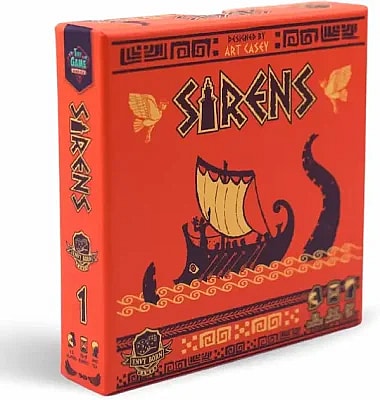
If you’re looking for the complete Sirens rules, this guide explains everything you need to know about how to play Sirens. Sirens is a fast-paced drafting and tableau-building card game for one or two players inspired by Greek mythology. Players take on the role of rival sirens competing to create the most beautiful song and lure sailors from a passing ship.
While Sirens is easy to learn, the game offers surprising depth. Every card you draft influences your melody, scoring opportunities, and future decisions. Because special rules change from round to round, no two games feel exactly the same.
A typical game lasts between 10 and 20 minutes and is played over several rounds. During each round, players draft cards, build songs, score their melodies, and attempt to capture sailors. The first player to attract enough sailors wins the game.
Components
The exact contents may vary slightly depending on the edition, but Sirens includes:
- Melody cards
- Key cards
- Universal Rule card
- Scoring card
- Score markers
- Rulebook
- Optional companion app
The companion app is not required to play, but it can play back the melody you created during the game.
Objective of the Game
The goal of Sirens is to create a song that scores better than your opponent’s song.
Each round represents a musical contest between rival sirens. The winner of the round attracts a sailor from a nearby ship. The first player to attract enough sailors—typically two sailors—wins the game.
Understanding the Theme
In Greek mythology, sirens used enchanting songs to lure sailors toward dangerous shores. Sirens transforms this concept into a strategic card game where players construct musical arrangements.
Instead of attacking opponents directly, you compete through clever drafting, efficient card placement, and maximizing scoring opportunities. Every card added to your melody affects how your final song will be evaluated.
The challenge comes from deciding which cards help your song the most while denying valuable cards to your opponent.
Game Setup
Before the first round begins, prepare the game as follows:
- Give each player a Key Card.
- Place the Key Card in front of each player.
- Put the Universal Rule Card where everyone can see it.
- Shuffle the main deck of melody cards.
- Draw one card from the deck and reveal it.
- Use that card to determine the special rule for the round.
- Place the revealed card into the discard pile.
- Deal four cards to each player.
You are now ready to begin the first round.
How a Round Works
Each round consists of several phases:
- Determine the round rule.
- Draft cards.
- Build your song.
- Score the songs.
- Award a sailor.
- Begin the next round.
Each phase is explained in detail below.
Phase 1: Determine the Round Rule
At the start of every round, one card is revealed from the deck.
This card is checked against the Universal Rule Card. Together they create a special rule that changes how the round is played or scored.
These changing rules are one of the game’s most interesting features. Some rules reward certain patterns, while others alter scoring priorities or create drafting restrictions.
Because the active rule changes every round, players must constantly adapt their strategy.
For example:
- One round may reward matching colors.
- Another may reward diversity.
- A different round may provide bonus points for certain card combinations.
The active rule applies to both players for the entire round.
Phase 2: Draft Cards
The drafting phase is the heart of Sirens.
Each player begins with four cards.
Both players secretly choose one card from their hand and place it face down in front of themselves.
Once both players have selected a card:
- Reveal the chosen cards.
- Pass the remaining cards to your opponent.
Each player then repeats the process:
- Choose one card.
- Reveal it.
- Pass the rest.
Continue until each player has drafted three cards.
The final unused card is discarded.
This drafting system creates meaningful decisions because every card you take is one less card your opponent can use.
You must constantly ask yourself:
- Does this card improve my song?
- Does this card hurt my opponent’s potential song?
- Is this card especially valuable under the current round rule?
Experienced players often spend as much time thinking during the draft as they do during scoring.
Example of Drafting
Imagine you receive these four cards:
- Red Note
- Blue Note
- Green Note
- Wild Note
The current round rewards matching colors.
You might choose the Red Note because it helps build a strong color group.
However, if you know your opponent is collecting red cards, taking the Red Note may also disrupt their strategy.
This creates an interesting balance between offense and defense.
Phase 3: Build Your Song
After drafting ends, players arrange their drafted cards to form a song.
A song is built by placing cards in a row connected to your Key Card.
Card position matters because many scoring opportunities depend on arrangement.
You are not simply collecting cards.
You are composing a melody.
When placing cards, consider:
- Card color
- Card sequence
- Matching symbols
- Current round rule
- Future scoring opportunities
The strongest song is rarely the one with the most powerful individual cards.
Instead, success comes from creating combinations that work together.
Understanding Song Construction
Think of your song as a puzzle.
Every card influences the value of the cards around it.
For example:
Card A may score bonus points if placed beside Card B.
Card C may score for every matching color connected to it.
Card D may benefit from being placed at the beginning or end of the melody.
The order of your cards can dramatically affect your score.
Because of this, placement decisions are often just as important as drafting decisions.
Scoring Categories
Songs are evaluated using four primary scoring categories:
Heart
Heart represents emotional impact.
Songs with strong emotional connections score well in this category.
Some cards naturally generate Heart points, while others create bonuses when paired with specific cards.
Parts
Parts reward structure.
Players score points by creating connected musical sections and combinations.
Building efficient groups often produces strong Parts scores.
Flow
Flow measures how smoothly your melody progresses.
Cards arranged in logical sequences often score well for Flow.
Disorganized songs usually perform poorly in this category.
Charm
Charm reflects the overall attractiveness of the song.
Certain card combinations create particularly charming melodies that earn additional points.
A song with high Charm may outperform a technically stronger song in other categories.
These four categories combine to create your final score.
Example of Scoring
Imagine your song scores:
- Heart: 6
- Parts: 4
- Flow: 5
- Charm: 3
Your total score would be:
18 points
Your opponent then calculates their score.
The player with the higher total wins the round.
Winning a Round
After both songs are scored, compare totals.
The player with the highest score wins the round.
The winner captures a sailor.
A sailor is represented by the card used to establish the round rule at the beginning of the round.
Place the sailor beside your Key Card as a trophy.
Captured sailors remain with you for the rest of the game.
Starting the Next Round
After a round ends:
- Gather cards.
- Shuffle if necessary.
- Reveal a new rule card.
- Deal four new cards to each player.
A new round then begins.
Scores do not carry over from previous rounds.
Each round is an independent contest.
Only sailors remain from round to round.
How to Win the Game
The game continues until one player captures enough sailors.
In a standard two-player game:
- First player to collect two sailors wins.
Because there are usually only a few rounds in a game, every scoring opportunity matters.
Solo Mode
Sirens also includes a solo mode.
Instead of competing against another siren, you compete against the legendary musician Orpheus.
The solo game uses similar scoring rules but changes how songs are built.
Rather than drafting against a human opponent, you decide which cards are added to your song and which are added to Orpheus’s song.
This creates an interesting puzzle where every choice affects both sides of the contest.
To win, you must defeat Orpheus multiple times. As the game progresses, Orpheus becomes increasingly difficult to beat.
Strategy Tips
Focus on Synergy
A collection of strong cards is not always enough.
Look for combinations that improve one another.
Three cards working together are often stronger than three individually powerful cards.
Draft Defensively
Pay attention to what your opponent wants.
Sometimes taking a card solely to prevent an opponent from using it is the correct move.
Adapt to the Round Rule
The special rule often determines the best strategy.
Players who ignore the active rule usually struggle to win rounds.
Plan During Drafting
Don’t wait until scoring to think about your song.
Begin planning your arrangement the moment you see your opening hand.
Learn the Card Pool
The more familiar you become with the available cards, the easier it becomes to predict what your opponent might draft.
Experienced players often gain an advantage simply through card knowledge.
Don’t Overcommit
If a strategy relies on finding a single specific card, it may be too risky.
Build flexible songs whenever possible.
Common Mistakes
Ignoring Placement
Card order matters.
Many beginners focus only on drafting and forget to optimize their layout.
Focusing on One Category
A balanced song often scores better than a song built around a single category.
Forgetting the Round Rule
The active rule can completely change scoring priorities.
Drafting Without a Plan
Randomly selecting cards usually produces weak songs.
Every draft pick should serve a purpose.
Frequently Asked Questions
Sirens is designed for 1–2 players. It can be played competitively with two players or as a solo challenge against Orpheus.
Most games take between 10 and 20 minutes.
No. The game can be played completely without the app. The app simply allows you to hear the melody you created.
Most games last two or three rounds, depending on how quickly a player captures enough sailors.
No. Scores reset each round. Only captured sailors remain.
Check the official rulebook for the specific tiebreak procedure used by your edition.
Conclusion
Sirens combines card drafting, pattern building, and tactical decision-making into a compact game that is easy to teach but rewarding to master. Every round challenges players to create the most captivating melody while adapting to changing scoring conditions. With quick playtime, meaningful choices, and excellent replayability, it works well as both a competitive two-player experience and a solo puzzle.
If you enjoy games that involve drafting cards and building combinations, you may also enjoy the popular card game Love Letter, which offers similarly quick gameplay and strategic decision-making in a small package.
Browse Related Games!
 Official Mancala Rules
 Official Gaia Project Rules
 Official The Lord of The Rings: Duel for Middle-Earth Rules
 Official Dixit Rules
 Official Targi Rules
 Official Creature Caravan Rules
 Official Pilgrim Rules
 Official Battleship Reloaded Rules
 Official TOSY Flying Ring Rules
 Official Mycelia Rules
 Official Guess Who? Rules
 Official Aquatica Rules