

Last Updated on November 5, 2025 by The Official Game Rules Team
7 Wonders Duel is a two-player strategy game set in the universe of the best-selling board game 7 Wonders. Designed specifically for head-to-head play, it challenges players to build civilizations by constructing Buildings and Wonders, developing military strength, advancing in science, and managing resources. With three paths to victory—military, scientific, or civilian—every decision counts, making 7 Wonders Duel an intense and strategic experience for players of all skill levels.

This post contains affiliate links. For more information, see our disclosures here.
How to Play 7 Wonders Duel
Table of Contents
Components | Objective | Setup | Gameplay | Description of Symbols | List of Cards | Organization of the Cards by Age | Strategy | FAQ
Game Components
- 1 Game Board
- 23 Age I Cards
- 23 Age II Cards
- 20 Age III Cards
- 7 Guild Cards
- 12 Wonder Cards
- 4 Military Tokens
- 10 Progress Tokens
- 1 Conflict Pawn
- 31 Coins (14×1, 10×3, 7×6)
- Scorebook, Rulebook, Helpsheet
Objective
Each player leads a civilization and constructs a city of Buildings and Wonders. Victory can be achieved in three ways:
- Military Supremacy – advance the Conflict Pawn to the opponent’s capital.
- Scientific Supremacy – collect six different scientific symbols.
- Civilian Victory – accumulate the most points by the end of Age III if no supremacy victory occurs.
Setup
- Place the board between the two players on one side of the play area.
- Place the conflict pawn on the neutral space in the middle of the board.
- Place the 4 Military tokens face up, on their spaces.
- Shuffle the Progress tokens and place 5 of them randomly, face up, on
the board. Return the rest to the box. - Each player takes 7 coins from the Bank.

Gameplay
Card Play Options
On your turn, choose an accessible card (not partially covered) and:
- Construct the Building – pay resources/coins, place it in your city.
- Construct a Wonder – pay Wonder cost; place Age card partially under the Wonder.
- Discard for Coins – gain 2 coins plus 1 per yellow card in your city.
Some Wonders grant extra turns when built.
Resources and Trading
- Production: Brown and grey cards, some yellow cards, and Wonders produce resources for the city.
- Trading: Missing resources can be purchased from the bank at 2 + opponent’s produced resources of that type coins each.
- Free Construction (Chains): Certain Buildings allow free construction of later Buildings in the chain.
Military
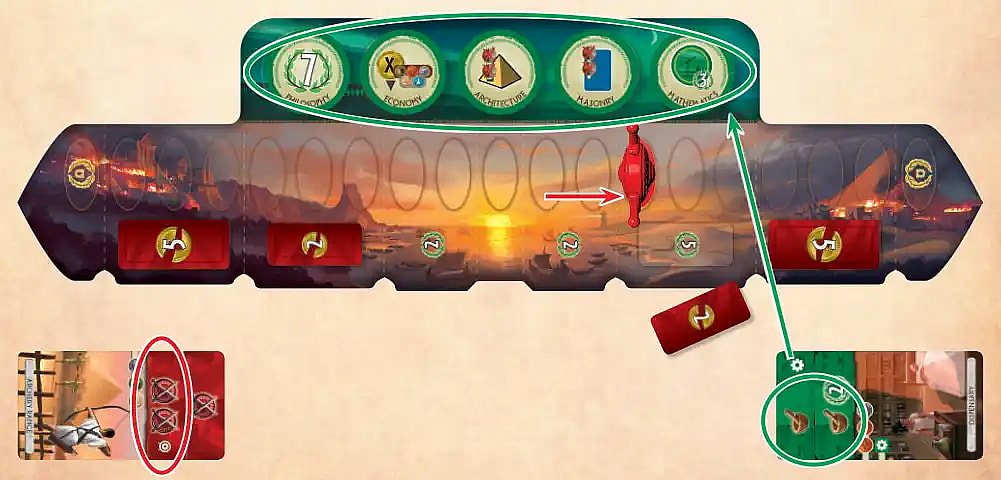
- Each shield on red cards or Wonders moves the Conflict Pawn toward the opponent’s capital.
- Entering a new zone triggers the Military token effect.
- Military Supremacy: Reaching opponent’s capital ends the game immediately.
Science and Progress
- There are 7 scientific symbols in the game.
- Collecting a pair of identical symbols allows claiming a Progress token.
- Scientific Supremacy: Collecting all six unique symbols ends the game immediately.
End of Age
- All Age cards must be played to complete the Age.
- The player with the weaker military begins the next Age.
Civilian Victory
If no supremacy victory occurs by the end of Age III:
- Add points from Military position, Buildings, Wonders, Progress tokens, and Treasury (1 point per set of 3 coins).
- Player with the highest total wins.
- Tie-breaker: most points from Civilian (blue) Buildings.
Description of Symbols
Military Tokens
- Looting Tokens (2 or 5 coins): Opponent loses the indicated coins, returned to the bank. If they don’t have enough coins, they lose all. Token is then removed from play.
Progress Tokens
| Token | Effect |
|---|---|
| Agriculture | Immediately take 6 coins from the bank. Worth 4 victory points. |
| Architecture | All future Wonders cost 2 fewer resources; you choose which resources. |
| Economy | Gain the money your opponent spends when trading for resources (excludes coins for card cost). |
| Law | Worth one scientific symbol. |
| Masonry | All future blue civilian Buildings cost 2 fewer resources. |
| Mathematics | At game end, earn 3 victory points per Progress token you own. |
| Philosophy | Worth 7 victory points. |
| Strategy | Future red military Buildings gain +1 Shield each. |
| Theology | All future Wonders built by you gain the “Play Again” effect. |
| Urbanism | Immediately take 6 coins from the bank. Gain 4 coins for each free Building built via chain. |
Age I, II, and III Cards
- Brown Cards: Produce raw goods (Clay, Wood, Stone).
- Grey Cards: Produce manufactured goods (Glass, Papyrus).
- Blue Cards: Civilian Buildings; grant victory points.
- Red Cards: Military Buildings; provide Shields.
- Green Cards: Scientific Buildings; grant symbols and victory points.
- Yellow Cards: Commercial Buildings; grant coins, affect trading rules, or victory points.
- White Symbol: Grants free construction of linked cards in later Ages.
- Coin Values: Some cards give coins depending on the number of Wonders or specific cards you have.
Guild Cards
| Guild | Effect |
|---|---|
| Builders Guild | 2 VP for each Wonder in the city with the most Wonders. |
| Moneylenders Guild | 1 VP for each set of 3 coins in the richest city. |
| Scientists Guild | 1 coin per green card in the city with the most green cards when built. 1 VP per green card at game end. |
| Shipowners Guild | 1 coin per brown and grey card in the city with the most such cards; 1 VP per card at game end. |
| Traders Guild | 1 coin per yellow card in the city with the most yellow cards; 1 VP per card at game end. |
| Magistrates Guild | 1 coin per blue card in the city with the most blue cards; 1 VP per card at game end. |
| Tacticians Guild | 1 coin per red card in the city with the most red cards; 1 VP per card at game end. |
Clarifications:
- Coins are collected only once at the moment of construction.
- End-of-game points can be scored from a different city than the one used for coin collection.
Wonders
| Wonder | Effect | VP | Shields |
|---|---|---|---|
| Appian Way | Take 3 coins from bank, opponent loses 3 coins, immediately take a second turn. | 3 | – |
| Circus Maximus | Discard one grey card of opponent’s choice. | 3 | 1 |
| Colossus | – | 3 | 2 |
| Great Library | Draw 3 Progress tokens from discarded, choose one, return the rest. | 4 | – |
| Great Lighthouse | Produces 1 Stone, Clay, or Wood each turn. | 4 | – |
| Hanging Gardens | Take 6 coins from bank, immediately play a second turn. | 3 | – |
| Mausoleum | Construct a discarded card for free. | 2 | – |
| Piraeus | Produces 1 Glass or Papyrus each turn, immediately play a second turn. | 2 | – |
| Pyramids | – | 9 | – |
| Sphinx | Immediately play a second turn. | 6 | – |
| Statue of Zeus | Discard one brown card of opponent’s choice. | 3 | 1 |
| Temple of Artemis | Take 12 coins from bank, immediately play a second turn. | – | – |
List of Cards
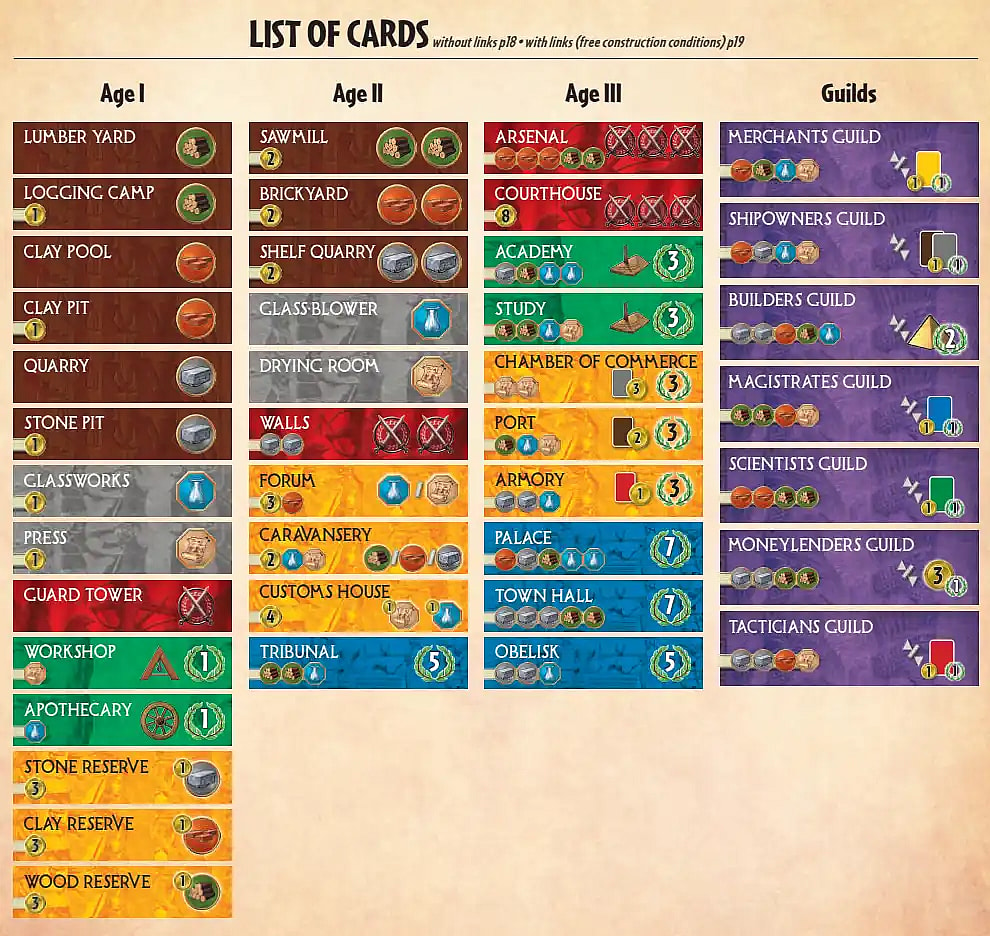

Organization of the Card Board Depending On Age
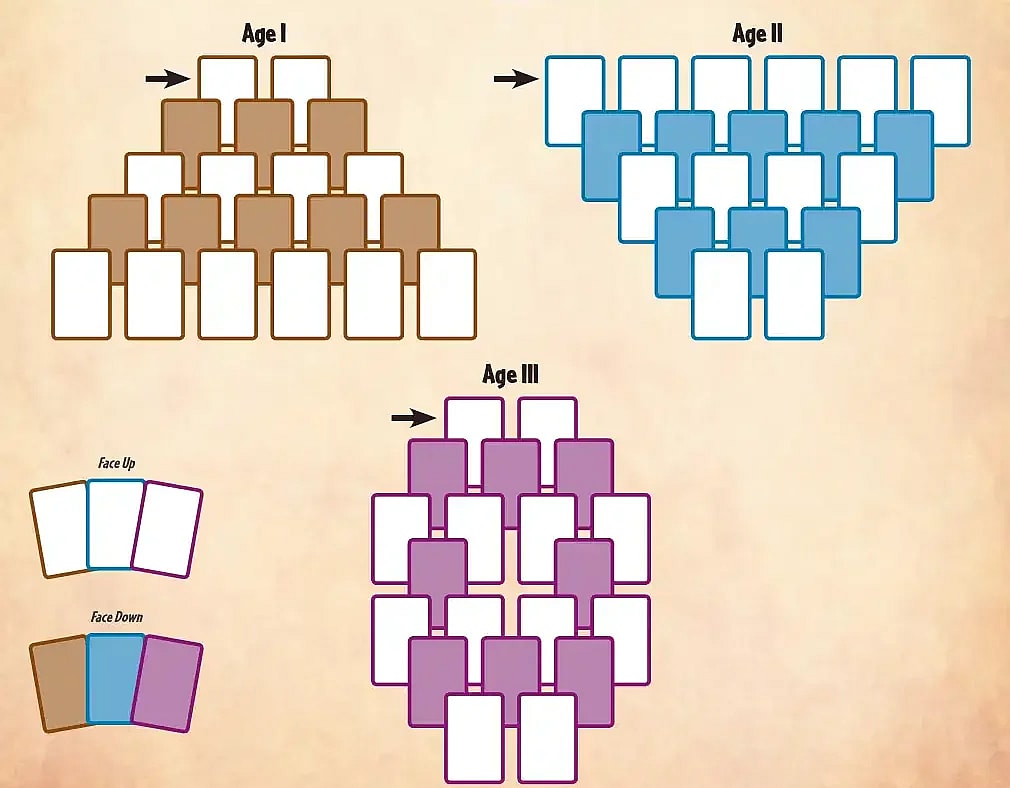
At the beginning of each Age, shuffle the corresponding deck, then lay out the 20 cards according to the structure of the current Age.
Be careful, some cards are laid out face up, and others face down. To make things easier, start at the indicated point.
Strategy Tips
- Balance Your Focus: Neglecting military or science can allow your opponent to secure a sudden victory.
- Resource Management: Build a production base early to reduce reliance on expensive trading.
- Wonder Timing: Construct Wonders strategically to gain extra turns or pivotal effects.
- Card Denial: Sometimes picking a card your opponent wants is more valuable than the card itself.
- Scientific Chains: Aim for Progress tokens that amplify long-term advantages.
- Military Pressure: Advancing the Conflict Pawn can force opponents to divert resources from other strategies.
FAQ – 7 Wonders Duel Rules
Approximately 10 cards per player per Age.
Yes, achieving either ends the game immediately.
2 coins plus 1 per opponent-produced resource of the same type.
A maximum of 7 Wonders are built in total.
The player with the most points from Civilian Buildings (blue cards) wins; if still tied, victory is shared.
Conclusion
7 Wonders Duel delivers a rich, competitive experience for two players, blending strategic planning, tactical card play, and careful resource management. With multiple paths to victory, every game is different, offering deep replayability and intense one-on-one challenges. Mastering military, scientific, and civilian strategies ensures each match is engaging and full of surprises.
Browse Related Games!
 Official Brass: Birmingham Rules
 Official Rajas of The Ganges Rules
 Official Mancala Rules
 Official Gaia Project Rules
 Official Power Grid Rules
 Official Jinx Rules
 Official TOSY Flying Ring Rules
 Official The Lord of The Rings: Duel for Middle-Earth Rules
 Official Pilgrim Rules
 Official Meadow Rules
 Official Creature Caravan Rules
 Official DCeased: Gotham City Outbreak Rules