

Last Updated on January 9, 2026 by The Official Game Rules Team
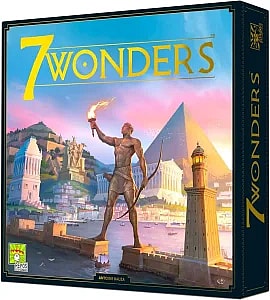
7 Wonders is a civilization-building card game where players develop powerful ancient cities over the course of the entire game. Using simultaneous card drafting, resource management, and tactical decisions, players construct structures, advance science, wage military conflicts, and build one of the world’s great wonders.
Played over three Ages, the game rewards long-term planning, adaptation to your opponent and neighboring city, and careful use of every single card. Victory is determined only at the end of Age III, when all victory points are totaled and the most successful civilization is crowned the winner.
This post contains affiliate links. For more information, see our disclosures here.
How to Play 7 Wonders
Object of the Game
The object of 7 Wonders is to score the highest number of victory points by the end of the game. Victory points come from many sources:
- Civilian structures (blue cards)
- Scientific structures (green cards)
- Military victories and defeat tokens
- Commercial structures (yellow cards)
- Guilds (purple cards)
- Wonder stages
- Coins remaining in your treasury
At the end of the game, the player with the highest number of points wins. In the case of a tie, the player with the most coins remaining is the winner.
Game Components
Each game of 7 Wonders includes the following components:
- 7 Wonder boards (double-sided with a day side and night side)
- 7 Wonder cards
- 49 Age I cards
- 49 Age II cards
- 50 Age III cards
- 42 conflict tokens (victory and defeat tokens)
- 20 coins worth 3
- 30 coins worth 1
- 1 score booklet
- 1 rulebook
- 2 special cards for the two-player variant
Beginning of the Game
Number of Players
The standard game supports 3 to 7 players. A special two-player variant is included and explained later.
Setup
Wonder Boards
- Shuffle the Wonder cards face down.
- Deal one Wonder card to each player.
- The card determines which Wonder board and which side (day or night) the player will use.
- Each Wonder board represents the player’s home city and shows:
- A starting resource
- The number of stages in the Wonder
- The resource cost and reward for each stage
For first-time players, it is recommended to use the day side, which is simpler and more forgiving.
Coins
Each player begins the game with 3 coins placed in their treasury. Coins are unlimited during play and are worth victory points at the end of the game.
Age Decks
The game is played over three Ages:
- Age I
- Age II
- Age III
Each Age uses a different deck of cards. Before the game begins, remove cards from each deck based on the number of players, following the icons printed on the cards.
For Age III, remove all purple cards (Guilds), shuffle them, and secretly add a number of Guilds equal to the number of players + 2 back into the Age III deck.
Overview of an Age
Each Age follows the same structure:
- Each player receives a hand of cards (7 cards at the beginning of the Age).
- Each Age consists of six game turns.
- On each given turn, players:
- Choose one card
- Perform one action
- Pass the remaining hand to a neighboring player
Direction of Play
- Age I: Pass hands to the left (clockwise)
- Age II: Pass hands to the right (counter-clockwise)
- Age III: Pass hands to the left again
This change in direction forces players to adapt their strategy every Age.
Turn Structure in Detail
Each turn has three clear steps.
Step 1: Choose a Card
Each player secretly selects one card from their hand. The chosen card is placed face down in front of the player.
The remaining cards are kept together and will be passed at the end of the turn.
Step 2: Perform an Action
Once all players have chosen a card, everyone reveals their card and performs one of the following actions simultaneously.
Action 1: Build a Structure
Building a structure is the most common action.
Structure Costs
Each card shows its cost in the upper-left corner:
- Free construction (no cost)
- Coin cost (paid to the bank)
- Resource cost
- Or a combination
Some cards also show a free construction chain, allowing the card to be built for free if the required structure was built in a previous Age.
You may never build two identical structures, even if they appear in different Ages.
Action 2: Build a Stage of a Wonder
Instead of building a structure, a player may build one stage of their Wonder.
- The chosen card is placed face down beneath the Wonder board
- The resource cost comes from the Wonder board, not the card
- Wonder stages must be built in order
- Each stage of a wonder provides a powerful benefit such as:
- Victory points
- Coins
- Military strength
- Extra turns
- Scientific symbols
Building a Wonder stage is optional, but it often provides strong advantages and helps deny cards to opponents.
Action 3: Discard the Card for Coins
A player may discard a card to gain 3 coins.
- The discarded card goes into a face-down discard pile
- This action is mandatory if a player cannot build a structure or a wonder stage
- Discarding is often used to:
- Gain coins for future turns
- Prevent an opponent from gaining a powerful card
Step 3: Pass the Hand
After resolving actions, players pass their remaining cards to the next player according to the Age’s direction.
Sixth Game Turn Rule
At the beginning of the sixth and final turn of each Age:
- Each player receives a two-card hand
- One card is chosen and played normally
- The last card is discarded face down without gaining coins
This ends the Age.
Card Types Explained
Brown Cards – Raw Materials
Produce basic resources:
- Wood
- Clay
- Stone
- Ore
These are essential early in the game and often form the backbone of a city’s economy.
Gray Cards – Manufactured Goods
Produce advanced resources:
- Glass
- Papyrus
- Textile
Gray cards are rarer and highly contested, especially in Age II and Age III.
Blue Cards – Civilian Structures
Provide straightforward victory points and are often a safe, consistent way to score.
Green Cards – Scientific Structures
Each green card shows one of three different symbols. Scientific scoring rewards:
- Sets of identical symbols
- Sets of three different symbols
Science can produce explosive point totals but requires careful planning.
Yellow Cards – Commercial Structures
Yellow cards provide:
- Coins
- Resource flexibility
- Discounts on buying resources
- Victory points (mostly in Age III)
They often synergize with other strategies.
Red Cards – Military Structures
Red cards add shields to a player’s city. Shields determine outcomes of military conflicts at the end of each Age.
Purple Cards – Guilds
Guilds appear only in Age III and score victory points based on:
- Your city
- Your neighboring cities
- Specific card combinations
Guilds can swing games dramatically.
Resources and Commerce
Producing Resources
A city’s resources come from:
- The Wonder board
- Brown cards
- Gray cards
- Some yellow cards
Resources are never consumed and can be used every turn for the entire game.
Buying Resources from Neighbors
If you lack required resources, you may buy them from a neighboring city.
- Cost: 2 coins per resource
- Only left and right neighbors may sell
- Players cannot refuse to sell
- Bought resources are used only for that turn
Some yellow cards reduce the coin cost of buying resources.
Military Conflicts
At the end of each Age, military conflicts are resolved.
How Conflicts Work
Each player compares their total shields to each neighboring city:
- Higher shields → gain a victory token
- Lower shields → gain a defeat token (-1)
- Equal shields → no token
Token Values
- Age I: +1
- Age II: +3
- Age III: +5
Defeat tokens are always worth -1 victory point.
End of the Game
The game ends at the end of Age III, after military conflicts are resolved.
Scoring Breakdown
Victory points are counted in this order:
- Military conflicts
- Treasury (1 VP per 3 coins)
- Wonder stages
- Civilian structures
- Scientific structures
- Commercial structures
- Guilds
The player with the highest total wins.
Strategy Tips for 7 Wonders
- Always watch your neighboring cities
- Science is powerful but risky if contested
- Military can be ignored early, but not forever
- Coins provide flexibility and break ties
- Denying opponents key cards is often as important as building your own city
FAQ
The standard game supports 3 to 7 players, with a special two-player variant included.
No, but ignoring military usually results in multiple defeat tokens.
No. A structure with the same name can only be built once per game.
No. Resources are permanent and reusable.
Conclusion
7 Wonders remains a cornerstone of modern board gaming thanks to its elegant drafting system, strategic depth, and minimal downtime. Every Age presents new challenges, and every card decision shapes not just your city, but the fate of your opponents.
If you enjoy 7 Wonders, you should also try 7 Wonders Duel for a focused two-player experience, or Splendor, another highly regarded engine-building game that rewards efficient resource use and long-term planning.
Browse Related Games!
 Official Brass: Birmingham Rules
 Official Santorini Rules
 Official Mycelia Rules
 Official Mancala Rules
 Official Gaia Project Rules
 Official The Lord of The Rings: Duel for Middle-Earth Rules
 Official TOSY Flying Ring Rules
 Official DCeased: Gotham City Outbreak Rules
 Official Meadow Rules
 Official Creature Caravan Rules
 Official Aquatica Rules
 Official Rajas of The Ganges Rules