

Last Updated on February 26, 2026 by The Official Game Rules Team
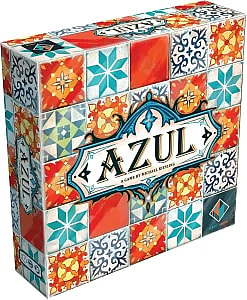
Azul is a modern classic among board games, designed by Michael Kiesling and inspired by the decorative ceramic tiles known as azulejos. These blue ceramic tiles were introduced to the Iberian Peninsula by the Moors and later embraced by the Portuguese. According to history, King Manuel I of Portugal visited the Alhambra palace in southern Spain and was captivated by the stunning beauty of the Moorish decorative tiles. Awestruck by the interior beauty of the Alhambra, he ordered that the walls of his own palace be decorated with similar wall tiles.
In Azul, players take on the role of tile artists tasked with decorating the walls of the Royal Palace of Evora. By drafting tiles, completing pattern lines, and carefully placing tiles onto a colored wall, players aim to score points while avoiding excess tiles that result in minus points. Simple to learn yet deeply strategic, Azul rewards careful planning, timing, and efficient placement.
This post contains affiliate links. For more information, see our disclosures here.
How to Play Azul
Object of the Game
The goal of Azul is to score the highest number of points by placing tiles onto your player board. Players score points during gameplay and earn additional points at the end of the game. The end-game is triggered when at least one player completes a full horizontal row of five consecutive tiles on their wall.
The player with the most points on the score track wins. In the case of a tie, the player with more completed horizontal lines wins. If there is still a tie, victory is shared.
If you enjoy Azul make sure to checkout Azul: Duel, an exciting two-player variant.
Game Setup, Player Boards, and Components
Each player receives:
- One player board (use the colored wall side for the normal game)
- One score marker, placed on space 0 of the score track
Unused player boards and score markers are returned to the box.
Factory Displays
Place the factory displays in a circle around the middle of the table:
- 2-player game: 5 factory displays
- 3-player game: 7 factory displays
- 4-player game: 9 factory displays
Tiles and Bag
Place all 100 tiles (20 of each color: blue tile, yellow tile, red tiles, black tiles, and one additional color) into the bag.
First Player Marker
The player who most recently visited Portugal takes the first player marker (sometimes called a ticket) and becomes the starting player for the first round.
That player draws tiles from the bag and places exactly four tiles onto each factory display.
Overview of Gameplay
Gameplay is divided into multiple rounds. Each round consists of three phases:
- Factory Offer
- Wall-Tiling Phase
- Preparing the Next Round
Players continue playing rounds until the end of the game condition is met.
Phase A: Factory Offer
Starting with the player who has the first player marker, players take turns clockwise.
On your turn, you must take tiles in one of the following ways:
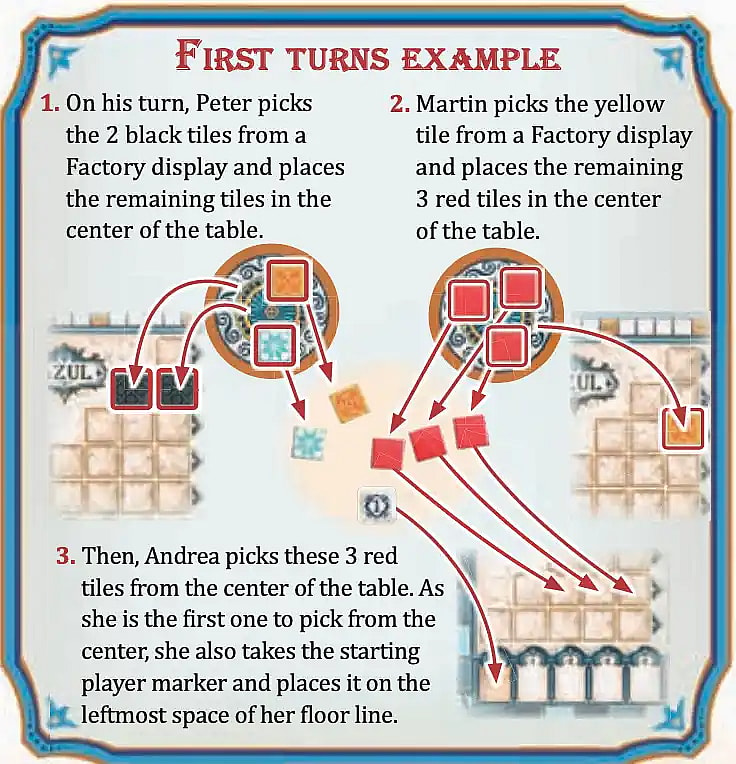
Option 1: Take Tiles from a Factory Display
- Choose one factory display
- Take all tiles of a single color from it
- Move the remaining tiles to the center of the table
Option 2: Take Tiles from the Center
- Take all tiles of one color from the middle of the table
- If you are the first player to take from the center this round, you must also take the first player marker and place it in the leftmost free space of your floor line
Placing Tiles on Pattern Lines
After taking tiles, you must place them onto one of the five pattern lines on your player board:
- First pattern line holds 1 tile
- Second pattern line holds 2 tiles
- Third pattern line holds 3 tiles
- Fourth pattern line holds 4 tiles
- Fifth pattern line holds 5 tiles
Tiles are placed from right to left. All tiles in a pattern line must be of the same color. You may not place tiles of a different color into a pattern line that already contains tiles.
A special restriction applies in later rounds: you may not place tiles of a certain color into a pattern line if the corresponding line of your wall already contains a tile of that color.
Excess Tiles and the Floor Line
If you take more tiles than can fit in your chosen pattern line, the excess tiles must be placed into your floor line. The spaces of your floor line fill from left to right.
Tiles in the floor line cause minus points during scoring. If all spaces of your floor line are filled, any additional tiles are placed into the lid of the game box.
End of the Factory Offer Phase
The factory offer phase ends when all factory displays and the center of the table contain no remaining tiles.
Phase B: Wall-Tiling Phase
All players resolve this phase simultaneously.
Moving Tiles to the Wall
Starting from the first line and moving downward, check each pattern line:
- If a pattern line is complete, move the rightmost tile of that pattern line to the corresponding wall line
- The tile must be placed in the valid space that matches its color
After placing the tile, remove the remaining tiles of that pattern line and place them in the lid of the game box. Incomplete pattern lines remain for the next round.
Scoring Points
Each newly placed tile scores points immediately:
- If there are no adjacent tiles, gain 1 point
- If there are adjacent tiles, score points based on linked tiles
First check horizontally:
- Count all consecutive tiles in the horizontal row, including the newly placed tile
- Gain that many points
Then check vertically:
- Count all consecutive tiles in the vertical column
- Gain that many points
If both apply, you score points for both directions.
Move your score marker accordingly on the score track.
Floor Line Penalties
After placing all tiles:
- Lose points for each tile in your floor line based on the printed values
- The starting player marker counts as a normal tile for penalties
- Your score may not drop below zero
After penalties, return all floor line tiles to the lid of the game box. Keep the first player marker in front of you.
Phase C: Preparing the Next Round
If nobody has completed a full horizontal line of five tiles, prepare the next round:
- The player with the first player marker refills all factory displays with four tiles each
- If the bag is empty, refill it using tiles from the lid
- In the rare case that there are not enough tiles, continue with partially filled factory displays
Then begin the next round.
End of the Game
The end of the game occurs after the wall-tiling phase in which at least one player completes a full horizontal line of five consecutive tiles on their wall.
End-Game Scoring
After the final round, players score additional points:
- 2 points for each complete horizontal line
- 7 points for each complete vertical line
- 10 points for each color of which all five tiles are placed on the wall
Add these points to your score track. The player with the highest total wins.
Strategy Tips for Azul
- Focus on completing pattern lines efficiently rather than grabbing many tiles early
- Avoid excess tiles to minimize minus points from the floor line
- Watch opponents’ boards to deny them tiles they need
- Completing vertical lines and full colors yields large end-game rewards
- Timing when to take the first player marker can strongly affect later rounds
- Plan ahead so your fifth pattern line aligns with future scoring opportunities
Advanced Variant (Gray Side)
For a slightly different game, use the gray side of the player boards:
- You may place a tile in any space of its corresponding wall line
- Each vertical column may still contain each color only once
- This variant increases flexibility but demands stronger planning
All other rules remain the same as the normal game.
FAQ
Azul supports 2-player, 3-player, and 4-player games.
No. If you take tiles, you must place them either in a valid pattern line or in your floor line.
All such tiles must go into your floor line, causing minus points.
Yes. Azul is easy to learn, visually appealing, and suitable for families while still offering deep strategy.
Conclusion
Azul combines elegant design, historical inspiration, and clever gameplay into a timeless tile-laying experience. Whether you are recreating the colored wall of a Portuguese palace or carefully managing tiles to avoid penalties, every decision matters. With simple rules, meaningful choices, and satisfying scoring, Azul remains one of the most beloved modern board games.
If you enjoy Azul, you may also like other tile-based or pattern-building games such as Sagrada or Patchwork, which similarly reward spatial planning and long-term strategy.
Browse Related Games!
 Official Ubongo! Rules
 Official Magnetic Chess Game with Stones Rules
Official Axis and Allies 1942 Rules
Official Magnetic Chess Game with Stones Rules
Official Axis and Allies 1942 Rules
 Official The Lord of The Rings: Duel for Middle-Earth Rules
 Official Bamboo Rules
 Official Root Rules
 Official Gaia Project Rules
 Official Rajas of The Ganges Rules
 Official The Night Cage Rules
 Official Panda Royale Rules
 Official Santorini Rules
 Official Everdell Rules